
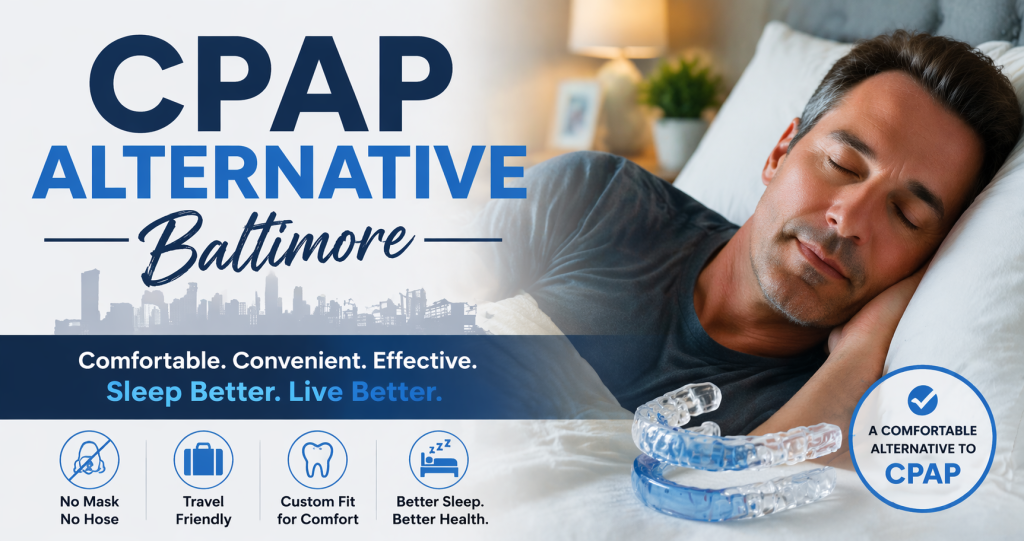
A Better CPAP Alternative in Baltimore — No Mask, No Hose, No Noise
If you've been prescribed a CPAP machine and you simply cannot stand wearing it, you are not alone. Studies show that nearly half of CPAP users stop using their machine within the first year — not because they don't want to feel better, but because the mask, the hose, and the constant whooshing noise make restful sleep nearly impossible. The good news is that there is a proven, comfortable, and clinically effective CPAP alternative in Baltimore, and it doesn't involve another machine. At Sleep Dentist Towson, Dr. Mark Shulman helps patients across Baltimore, Towson, Timonium, and throughout Baltimore County finally get the restorative sleep they've been missing — without the CPAP.
The alternative is called Oral Appliance Therapy. It's a custom-fit dental device — about the size of a night guard — that gently holds your lower jaw in a position that keeps your airway open while you sleep. No straps. No electricity. No compressor running in the corner of your bedroom. It's small enough to fit in the palm of your hand, and most patients say they forget they're wearing it within a few nights. Best of all, it's recognized by the American Academy of Sleep Medicine as an effective first-line treatment for mild to moderate obstructive sleep apnea and for patients who cannot tolerate CPAP.
Frequently Asked Questions About CPAP Alternatives in Baltimore
1. Is an oral appliance really as effective as a CPAP machine?
For many patients, yes. Clinical research shows that oral appliance therapy is highly effective for mild to moderate obstructive sleep apnea, and research consistently shows higher compliance rates than CPAP — meaning patients actually wear the device every night, which is what produces real health results. Dr. Shulman will review your sleep study and medical history to determine whether oral appliance therapy is the right fit for your specific situation.
2. Will my doctor approve this CPAP alternative?
Most sleep physicians are supportive of oral appliance therapy, especially for patients who have documented CPAP intolerance. In fact, many doctors actively refer patients to us when CPAP isn't working. We're happy to coordinate directly with your physician to ensure your treatment plan is medically sound and properly documented.
3. Do I need a new sleep study to switch from CPAP?
Not always. If you have a recent sleep study on file (typically within the last 2–3 years), we may be able to use it. In some cases, a follow-up home sleep test is recommended after you've been wearing the appliance to confirm it's working effectively. We'll guide you through every step so nothing is left to guesswork.
4. Is a CPAP alternative covered by insurance?
Often, yes. Because sleep apnea is a medical condition, oral appliance therapy is typically covered under medical insurance (not dental insurance). Many patients find that medical coverage — including Medicare in many cases — handles a significant portion of the cost. Our team will verify your benefits in advance and explain your out-of-pocket expense before treatment begins.
5. How long will it take to get used to the appliance?
Most patients feel comfortable within a few nights to a week. The appliance is completely custom-made for your bite, so it fits snugly and securely. Dr. Shulman will follow up with you for several fitting adjustments to make sure the appliance is comfortable and therapeutically effective.
6. Can I still use my CPAP occasionally while trying the appliance?
Yes. Some patients choose to transition gradually, using the appliance most nights and the CPAP only when needed. Others stop CPAP entirely once the appliance is calibrated. Your transition plan will be discussed at your consultation so you feel fully in control of the process.
7. Will the oral appliance work for severe sleep apnea?
Oral appliance therapy is most commonly recommended for mild to moderate obstructive sleep apnea. However, many patients with severe sleep apnea who cannot tolerate CPAP also benefit from oral appliance therapy — sometimes as a standalone treatment and sometimes in combination with CPAP at lower pressures. Dr. Shulman will help you determine if oral appliance therapy is right for you.
8. I live in Baltimore City — where is your office located?
We're located at 20 E. Timonium Rd., Suite 211, in Timonium, MD 21093 — just a short drive north of Baltimore City via I-83. Patients come to us from Federal Hill, Canton, Mt. Vernon, Fells Point, Roland Park, Hampden, Towson, Timonium, and across the greater Baltimore metro area.
Why So Many Baltimore Patients Can't Tolerate CPAP
CPAP therapy saves lives — there's no question about that. But the reality for many people is that the CPAP mask simply doesn't allow for restful sleep. Common complaints we hear from Baltimore-area patients include claustrophobia from the mask, dry mouth, a runny nose, air leaks that wake them up, skin irritation, inability to sleep on their side, pressure sores, partner disruption from the noise, and the sheer difficulty of traveling with a bulky machine. If any of these sound familiar, you're not stuck. A proven CPAP alternative in Baltimore is available right here.
Understanding what sleep apnea really is helps clarify why there's more than one way to treat it. The goal of any sleep apnea treatment is simple: keep the airway open so breathing doesn't stop during sleep. CPAP does this by forcing pressurized air into your throat. An oral appliance does it by holding your jaw in a position that naturally keeps the airway open. Different approaches, same goal — and for many patients, one is far easier to live with than the other.
Oral Appliance vs. CPAP — A Side-by-Side Comparison
| Feature | Oral Appliance | CPAP Machine |
|---|---|---|
| Mask required? | No | Yes |
| Hose required? | No | Yes |
| Electricity required? | No | Yes |
| Travel-friendly? | Yes — fits in a pocket | Bulky carry-on |
| Noise during sleep? | Silent | Constant airflow noise |
| Compatible with any sleep position? | Yes | Limited by mask |
| Custom-fit to you? | Yes — every time | Standard masks |
| Long-term compliance? | Typically very high | Often low |
Why Patients Choose Dr. Mark Shulman for Their CPAP Alternative
Choosing the right provider matters. Dental sleep medicine is a specialized field, and not every dentist is trained to design and fit oral appliances at the level of precision sleep apnea treatment requires. Dr. Shulman has dedicated his practice specifically to helping patients sleep better — it's not a side service, it's his focus.
Dental Sleep Medicine Focus
Dr. Shulman works exclusively in dental sleep medicine, not general dentistry.
Precision Custom Fit
Every appliance is designed specifically for your bite, jaw, and airway — no off-the-shelf devices.
Physician Coordination
We work directly with your sleep doctor to keep treatment medically aligned.
Medical Insurance Billing
Our team handles the paperwork so you can focus on getting better sleep.
Veteran-Owned, Veteran-Friendly
Dr. Shulman is a veteran who proudly helps fellow service members.
Long-Term Care
We stay with you through follow-ups, adjustments, and ongoing care.
How the Process Works
Step 1: Consultation
We'll review your symptoms, existing sleep study, and CPAP history. If you're a good candidate, Dr. Shulman will walk you through your options in plain language.
Step 2: Insurance Verification
Our team contacts your medical insurance carrier, verifies coverage, and gives you a clear cost estimate before you commit.
Step 3: Custom Impressions
Using precise digital scans, we capture your bite and airway anatomy so your appliance is tailored perfectly to you.
Step 4: Delivery & Fitting
Your custom appliance is delivered and adjusted in-office for a secure, comfortable fit. You'll begin using it that night.
Step 5: Follow-Up & Titration
Dr. Shulman sees you for several follow-up visits to fine-tune the appliance for maximum comfort and effectiveness. A home sleep test may follow to confirm results.
🛡️ Trust & Credentials: Dr. Shulman is a proud member of the American Dental Association (ADA), Maryland State Dental Association (MSDA), and Baltimore County Dental Association, with active engagement in dental sleep medicine education and training.
Who Should Consider a CPAP Alternative?
- Patients who have been prescribed CPAP but cannot tolerate the mask or hose.
- Patients with mild to moderate obstructive sleep apnea.
- Frequent travelers who find it difficult to bring a CPAP on trips.
- Patients who experience claustrophobia with a mask.
- Partners of CPAP users who are kept awake by the machine's noise.
- Patients who want a quieter, more discreet treatment.
"Dr. Shulman did an excellent job fitting me for an oral device to prevent my apneic episodes. He is personable, as well as highly skilled in his field. My new device fits me well, and Dr. Shulman took care of any adjustments that were necessary. His staff is courteous and professional. I only have high praises for my experience."
— Chava D., Sleep Apnea Patient
Serving Baltimore and the Surrounding Communities
Our Timonium office is a short, convenient drive for patients throughout the Baltimore metro area — including Baltimore City, Towson, Lutherville, Cockeysville, Hunt Valley, Pikesville, Parkville, Owings Mills, and White Marsh. If you're serious about finding a real CPAP alternative in Baltimore, we'd be honored to help you explore whether oral appliance therapy is the right next step. You don't have to keep fighting with a machine you can't stand. A better night's sleep is genuinely within reach.
Stop Fighting Your CPAP. Start Sleeping Again.
Schedule your consultation with Dr. Shulman and discover a comfortable, proven CPAP alternative.
Request Your Free Consultation Call 410-832-5858 Take the Sleep Apnea Quiz